Program Fira B! 2025
Frankenstein, autoritratto d’autrice
LaTâche21
“Invention does not consist of creating something out of nothing, but out of chaos.”
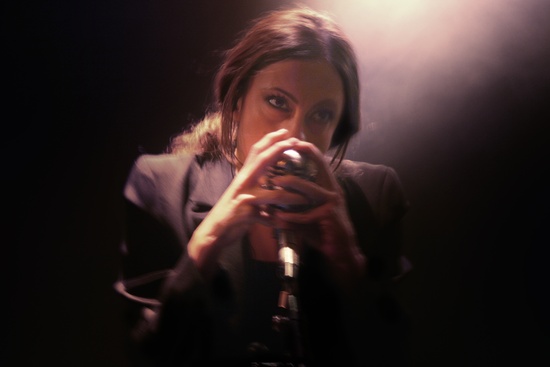
Like a game of mirrors between creator and creatures, Margherita Saltamacchia plays through voice with the characters of the novel to dissect the relationship between Mary Shelley and her creature Victor Frankenstein, and Victor Frankenstein with his creature.
Three characters merging into one. One character reflected in three. A microphone. An electric guitar.
The birth of Mary Shelley (1797–1851) caused the death of another Mary, her mother Mary Wollstonecraft (1759–1797), a renowned radical writer and pioneer of feminism. This work is a self-portrait. The author is, indeed, Mary Shelley, who in 1816, at the age of 19, wrote Frankenstein, or The Modern Prometheus, entering fully into literary history.
From the very beginning, the themes of creation and death influenced the young author. That book is her masterpiece. It is also her self-portrait. Mary Shelley was a young widow when she decided to tell her story, rewriting the preface to her novel in the 1831 edition, retracing the steps of her life that led her to literary creation.
“My life appeared to me a matter too trivial,” she writes. But it is precisely these passages that provide us with the key to understanding her work and from which our piece originates.
At a time when intellectual life was still almost exclusively dominated by male figures, Mary Shelley, one of the few female intellectuals of the period, appeared like a luminous comet.
It is no surprise, then, that the theme of creation takes on new and strikingly modern connotations in her work: hers is a purely feminine perspective, one that pushes to its extreme the archetypal contradiction between a woman’s ability to give life, on the one hand, and a man’s need to create substitutes for life, on the other.
In terms of personal biography, this theme acquires tragic connotations: as a woman, her innate creative potential collapsed again and again with the premature death in infancy of three of her four children.
Like a game of mirrors between creators and creatures, Margherita Saltamacchia plays with the characters of the stage narrative to dissect the relationship between Mary Shelley and her creature Victor Frankenstein, and Victor Frankenstein with his creature.
- The show contains scenes of nudity.
Credits:
- From the texts of Mary Shelley
- By and with: Margherita Saltamacchia
- Original live music: Christian Zatta (electric guitar)
- Dramaturgy: Cristina Galbiati
- Costumes: Marianna Peruzzo
- Lighting design: Marzio Picchetti
- Technical direction: Alexander Budd
- Voice processing: Fabio Martino - LaCorte Recordings Studio
- Production: Teatro Sociale Bellinzona - Bellinzona Teatro 2020
- Co-production: LaTâche21
LaTâche21
Theatrical productions.
A project of artistic research and sharing.